Help Stop the Plan to Licence Farmers to Shoot Wombats

Protect wombats from being killed out of convenience.

There are many ways to address wombat issues that don’t require killing. 

Support our campaign for humane, sustainable and evidence-based ways for people and wildlife to live alongside each other.

The Problem

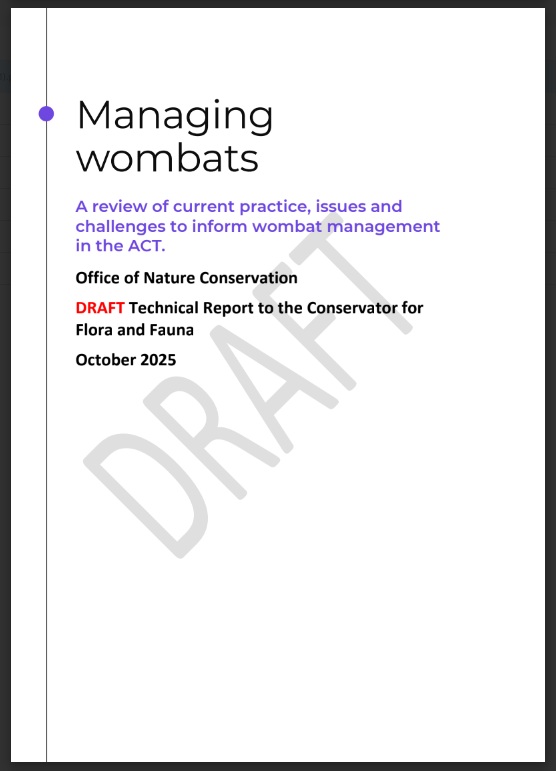
In early December, the ACT Government released a draft Technical Report on Managing Wombats – but only for stakeholder comment, not public consultation.

The report responds to complaints from a few farmers claiming there are too many wombats and they are damaging their land.

Based on these anecdotal reports alone – with no ecological evidence showing ‘management’ is even necessary – it makes 5 recommendations.

Two of those recommendations provide pathways to allowing farmers to be licensed to legally shoot wombats on their land, if approved by the ACT Environment Minister.

Here’s what’s missing: there’s no data on wombat population sizes or their actual impacts. Most ACT landholders haven’t been consulted. This report is a response to complaints from a handful of farmers, not facts.

Why This Matters

Wombats are protected native wildlife. They already face threats from habitat loss, mange, vehicle strikes and now legal shooting if this draft report goes ahead without changes.

If left unchanged, the recommendations in this draft report pave the way for wombats, which are currently protected, to become a “controlled native species”. This could allow legal shooting by farmers with few controls.


5 Key Problems with the Draft Report


1. Major evidence gaps are acknowledged, yet shooting still recommended

  • Despite 381 farmers in the ACT, the report acknowledges “only three rural leaseholders were consulted” (p26, p34).
  • The damage claims throughout the report are based on these three consultations and “anecdotal reports” (p20-21), not independent verification or systematic data collection.
  • The Report admits it lacks population data (p20), has no damage tracking system (p55-56), and hasn’t tested coexistence methods locally (p7).
  • Despite these fundamental evidence gaps, it recommends proceeding on pathways to lethal control (p60).

2. The Government doesn’t know how many wombats there are: no population or distribution data

  • The Report admits “There are currently no reliable estimates of abundance for Bare-nosed Wombats in the ACT” (p20).
  • Claims about population increases come from “anecdotal reports from leaseholders” and “anecdotal evidence from park rangers” (p20-21), not from systematic surveys.
  • Without knowing how many wombats there are, claims of “too many” wombats cannot be proven.
  • “Overabundance” implies a measurable threshold, yet no scientific studies define what that threshold is for wild wombat populations, nor who has the authority to declare it.
  • The Government cannot manage a population it hasn’t counted.

3. There is no evidence that wombats are causing the damage

  • The Report acknowledges there is no system for tracking wombat damage – farmers “currently do not have a method of reporting wombat impacts on their property” (p7, p55-56).
  • The damage claims from the three farmers have not been verified.
  • The Report acknowledges research stating that perceived damage can sometimes be disproportionate to actual damages (p55).
  • Even for erosion – a key concern – the report admits “targeted monitoring” is needed “to determine the extent and underlying cause” (p34-35).
  • There is no evidence that wombats are causing the problems claimed.

4. Shooting could be allowed without requiring farmers to try alternatives first

  • The Report recommends pathways to allowing farmers to shoot wombats on their properties (p60) without requiring them to first try the fencing, deterrents, or burrow management methods it describes.
  • The Recommendations only “support” non-lethal methods (p60) – they don’t “require” them. This means farmers could receive information about alternatives but choose to simply shoot wombats instead.
  • The Report discusses coexistence methods like electric fencing, wombat gates, and deterrents (p45-55), but admits “Many have not been trialled in the ACT” (p7).
  • Much of the cited research is based on the Southern Hairy Nosed Wombat, a different species. For key methods like deterrents, there is “No known research…on Bare-nosed Wombats” (p51).

5. A pathway to licenced shooting is recommended for severe mange instead of using the community’s existing mange treatment system

  • Many severely mangy wombats can be successfully treated and returned to full health. Yet the Report recommends “developing an appropriate mechanism to allow humane euthanasia of wombats on rural lands that are afflicted with severe mange” (p7). 
  • Wildlife rescue groups already provide free treatment to anyone who reports a mangy wombat – including farmers.
  • The Report notes that “some leaseholders are reluctant to allow property access to wildlife carers to treat mange affected Bare-nosed Wombats” (p27).
  • Instead of addressing this access barrier, the Report recommends moving towards allowing euthanasia on rural lands for very mangy wombats (Recommendation #2, p7). This pathway would enable a new licenced shooting system rather than improving access and collaboration to enable treatment.

Why Shooting Doesn’t Solve the Problem

Shooting wombats does not address underlying issues. Removing wombats from an area creates vacant territory that is quickly reoccupied by other wombats, perpetuating the cycle of conflict.

Shooting also:

  • Causes serious welfare issues – wounding, orphaned young, disrupted burrow systems
  • Doesn’t address the root causes of human-wombat conflict
  • Requires ongoing costs forever, while many non-lethal solutions are one-time investments

The ACT should lead on wildlife coexistence, not follow other states into allowing shooting. Wombats play important ecological roles – their burrows aerate soil, improve water infiltration, and they provide shelter for other species, including during bushfires.

The ACT has a unique opportunity to demonstrate that effective, humane wildlife management is possible.